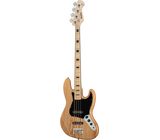
I got the bass about two years ago on a whim to see what's all the fuss about with Harley Bentons.
When I got it, out of the box, it played and felt good. Tuned it up and was ready to go. Setup was done well, so I didn't have to do much. I noticed right away that the bass is noisy, but it is a jazz bass copy with single coil pickups, so I knew what was I getting into. The pickups are Roswell, brand I've never heard of. Probably Thomanns house brand, not the best out there but not the worst either. OK, sounding but nothing to write home about.
It held tuning pretty well and was stable enough to play in rehearsals.
Where it really shined was the looks department. It looks amazing with that ash body, maple neck, and fingerboard.
Now, fast forward two years, I decided to modify it. I replaced the tuners with Shallers, the stock bridge with a Gotoh, new strap buttons, and string retainer. Then, the time came to replace the pickups. I went with an EMG solderless passive set because I didn't feel like routing a battery compartment for the active ones. I took the time and shielded the electronics with copper tape as well.
When I plugged the bass in after modifications, the difference was very noticeable. The pickups made all the difference. Like I said, the original ones were not that bad, but compared to EMGs, they are really lacking. The bass is now dead silent, holds a way better tuning, and is much more stable overall. The pickups are higher output than the stock ones, so the bass has a pretty nice growl.
Don't get me wrong, I don't want to bash Harley benton here. All of those modifications would not be possible if they didn't build a good overall skeleton.
I must say the best feature on that bass when it was completely stock is the neck. It is very stable, doesn't move a single bit, and even after all that surgery, I did a setup and found that I didn't have to adjust the trussrod at all. In its stock form, this bass is a very good beginner instrument. I got it with modifications in mind. And for that, you won't get a better platform.
The bass itself was around 170€. I put another cca 350€ of modifications in it and got a pretty nice mid range instrument. So now we are talking 520€ which is the price of a new higher range Squier, which still doesn't have Shaller tuners, Gotoh bridge, EMG pickups, EM shielding, and tend to be noisy so people modify them as well. The price of a bass with all that from factory and made from the same woods would be much higher.
So, in conclusion:
1. Wood construction is top-notch. You won't get a better moding skeleton for the money anywhere else.
2. From the get-go, it is a good beginner bass that won't set you back a lot of money.
3. Stock electronics were not the best out there but not the worst either. I've heard waaaaaay worse than that. It is a completely usable bass in its stock form. It shoots way above its class, considering the price
4. Neck is the best feature on the bass overall. I own instruments that I have to set up every season change. Not this one.
5. It is body heavy. Which is a good thing because there is no neck dive. If it had a lighter body, that huge headstock would tend to dive the neck.
6. For moders. All the parts have more or less direct replacements. I had to drill new holes for the Shallers (two were lined up per tuner, and two had to be redrilled). A 7 mounting hole Gotoh bridge fit 90%. I had to redrill the upper two holes, while the bottom 5 fit perfectly. EMGs solderless passive set fit perfectly. There is no need to redrill the holes or to route the pickup cavities. I think they build those basses knowing very well that people are going to modify them.